Showing posts with label gender. Show all posts

Tuesday, April 22, 2014

Immigrant Crossing: Intersecting Race and Gender

Next week, I am releasing a novel about an immigrant who is accused of murder. The book is a thrilling and creative exploration of what it means to be an American, and who gets to make that decision. We glorify the immigrants who crossed the country in covered wagons, and the immigrants who first landed at Plymouth Rock, while militarizing the southern border and deifying new immigrants as gangs of thugs. The reasons for these seemingly complicated conflicting feelings are rooted in the same old triumvirate of dickishness; subjectification, the warrior/thug complex, and the consolation prize.

OH MY GOD! THE HORDES!

In 2011, I wrote about how Tom Tancredo and his masculinity clones were attempting to highlight the MS-13 gang as an example of how immigrants from Latin America were thugs. We pick a group with whom we identify, and label outside groups as thugs. This is the Warrior/Thug Complex. With immigration, it's easy. Immigrants come from other cultures,
Yeah! A wall. It worked so great for the Chinese!
they often speak other languages, and usually speak it with a funny accent (like those darn Canadians). Best yet for deciding who is not a proper warrior, immigrants from lower latitudes are usually brownish. It's like a storm trooper's uniform except they can't take it off.

In a society that suffers remarkably little violent crime, masculinity will not survive unless males can be convinced that they are at risk of imminent violence at any moment. Thugs must be identified in order to allow men to be warriors, otherwise advocates of irrational violence just seem like tinfoil hats (thanks to Eric Schultz for that phrase). Immigration provides masculinity in the new world and increasingly in Europe with hordes of thugs needed to make men believe they must continue to glorify violence or suffer the consequences.

ESL- English as a Second cLass Marker

Americans of a certain educational class get goose pimples every time they spot errors in how people use English. We cite old wives' tales as grammar rules, and try to pretend that language is static. This is ridiculous considering just how rapidly language evolves, and is ever-evolving. Just consider that the word selfie is now in every major American dictionary.

Sorry to those looking for solid rules. Language doesn't fit into neat categories,
and when it does it is still evolving and changing.
1- Ever heard of sarcasm? e.g. "I could care less by completely ignoring you."
2- Except in a plural acronym e.g. M.D.'s.
3- Just because 'literally' is the antonym of 'figuratively' does not mean it cannot be used figuratively. If that were true, it would be bad grammar to write the word 'large' in a small or medium-sized font.
8- Except when 'effect' is a transitive verb.
10- Just because it's nonstandard, doesn't mean it's not a word.
Addendum i- Prepositions are fine to end sentences with. Please stop spreading this old wives' tale. To quote Churchill, "This is just the sort of nonsense up with which I will not put."
Addendum ii- I find it ironic when people claim there is only one narrow definition of  'irony.'
Conclusion- Grammar is a nefarious tool to discover those who don't belong.
Feel free to use proper grammar, but don't think less of those who don't!
The reality is that grammar is now what it has always been, a way of telling the unwashed masses from the educated elite. When a grammar sheriff of Nottingham tells Robin Hood that he should not end a sentence with a preposition, he is reflecting the belief of extreme elitists from the 17th Century who designed a grammar which reflected Latin in order to better determine which of their peers had been to a proper Latin college (i.e.- not Shakespeare).

Today, we mostly use grammar and "proper English" to determine who has been middle class or above for long enough to be considered properly American, and therefore a properly subjectified man (or privileged woman). Better yet, by pointing out "errors" in grammar, we can objectify others instead of considering the substance of their ideas, arguments, and legitimate claims at liberation. By focusing on how an Asian immigrant speaks funny, or on how black men don't speak "white," we can lump these people into groups less deserving of the consolation prize.

Overseers Over Seeing

And our consolation prize is the same as it was in the antebellum south. We are White (Straight) Men. This fact may alienate us from our children, other men, even our wives and lovers, but at least we are at the top of the heap, the head of the pack. Even within the group of white men, we may not be the CEO in charge of Georgia Pacific Paper Company (The Koch Brothers), or even a small-business owner. But at least we are not brownish. Seeing the welfare state erode before us, knowing that starvation and ostracism awaits us if we fail to succeed as proper men, we are rightfully terrified that we could fail even if we are hard working and relatively competent. Most men don't realize that it's just a Cracker Jack prize. We have little individual control over our economic situations, even if we are white, but we have a little more than those brownish guys do.

Give us your sick, tired, and poor
so that we can laugh at them as
we point out how they are not real men.

Immigration is the great story of the new world. If America is exceptional, it is not exceptional like a souffle. It is exceptional like a potager, a mix of all the vegetables in the garden in one tremendous stew. It seems like blindness that leads so many Americans to fight each wave of immigration, or complete disregard for history. I assure you it is not. The reason that Sheriff Joe is elected to office repeatedly in Arizona isn't that people don't know how important immigration is to our success, but because immigration provides too great a foil for American masculinity. Hating immigrants is one of the costs of masculinity.

On its own, masculinity is a great weight on men. We would not carry that burden unless there were carrots and sticks. Xenophobia provides both. It is another part of masculinity that we must dismantle before we can be free.

Tuesday, January 28, 2014

Everyday Man: Pancakes (Mancakes?)


photo by Alan Walker
Masculinity often focuses on the once in a lifetime stuff. Great men are presidents, generals who win decisive battles, thought leaders who come up with one amazing theory, and athletes who win the big game and set the big record. While we admit that nobody says on their death bed that they wish they'd spent more time at work, somehow all that gets lost in the everyday as even those who have enough accept more money to take on the harder job and spend more time working.


Part of what women perfected over the course of eons was living for today. That didn't mean going bungee jumping, or checking things off their bucket list. After all, the bucket list is simply another way of living for the future by saying, "these are the things I want to do before I die." Living for today means making pancakes for breakfast, not because it's a special occasion, but because when we make pancakes we take care of ourselves and the people we love.

After several years of making pancakes at least one hundred times a year, I have learned from my fore mothers and put together a delicious, healthy, everyday pancake recipe that you can make in 20 minutes for a family of four. The ingredients are listed below.

food production as women's work
Putting together these pancakes is more than just providing a substantive meal for my family, it is a meditation in the things that so many boys never get to learn. It's been called "learned helplessness," but it's more than the fact that college kids don't know how to arrange their lives in a healthy and organized manner. It is the forgetting of feminine knowledge. In a few short generations, we have handed over much of our women's work, like preparing food, hosting friends and family, and repairing our clothes to agribusiness, the internet, and the garment industry. When we do this, we trade satisfying tasks considered feminine, for masculine tasks that are repetitive, abusive and undervalued. This lost knowledge is taking its toll on our diets, our environment, our pocket books, and our mental and emotional health. One major flaw with "Lean In"-style feminism is the failure to recognize the value of traditionally women's work, like making pancakes.


food production as masculine labor

As I briefly mentioned in the last blog, pay equity is a very masculine way of looking at gender equality. It is an important index, but other indices, such as time spent with one's children, health of one's domestic sphere, and closeness and number of friendships are harder to calculate, and have not been the focus of modern feminists. It is no accident that pancakes have not been the primary worry of feminists. But when feminists emphasize equality in the spheres of politics and labor to the exclusion of traditionally feminine areas, they allow extreme masculinity to dictate the terms of the movement. By contrast, the basic tenant of masculine liberation is that feminine knowledge is inherently valuable as it is, not because the masculine marketplace acknowledges its value monetarily, but because things like domestic labor and deep loving friendships are valuable in themselves for both men and women.

So, regardless of whether you are a man, a woman, or neither, take a few moments to liberate yourself a little by connecting with your friends and family over a delicious homemade (not from a box) pancake breakfast. It will be worth it.


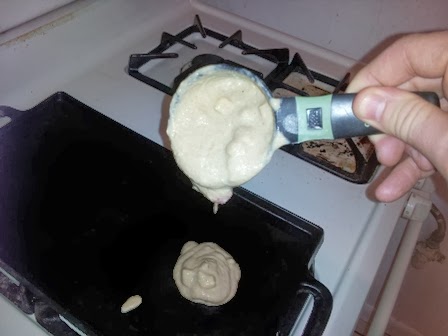
Gather all of your implements and ingredients before you start cooking. Put your griddle over the stove at the low end of medium. You'll have to figure out the temperature yourself, but because the structure of this particular pancake batter is so robust, you have quite a lot of room for error. Whisk together the flour, baking powder, and sugar, then use the whisk to mix together the applesauce, milk, eggs, and oil in a separate bowl. Mix the liquid into the dry ingredients with a fork or spatula at first, but finish mixing with the whisk. Add milk one tablespoon at a time until the batter oozes through the whisk. See the video below to see a good consistency.

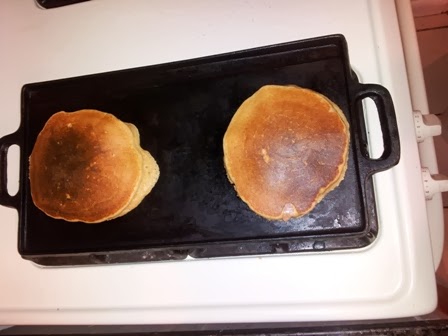
If you want to add ingredients, like chopped up apples and cinnamon, or dried cherries, add them at the end. Use your 1/2 cup measuring cup to pour the batter onto the griddle and flip after about three minutes. If you want, you can keep them warm in an oven at 180 for up to 30 minutes. Eat up and enjoy often.

Using the applesauce and white whole wheat flour makes these pancakes low calorie, moist, fluffy, and delicious, but you can trade up the applesauce and milk for buttermilk, and the flour for all-purpose if you want them fluffier for a special occasion.

When you buy pancake mix, you are paying factories money to mix the dry ingredients together, and maybe add some powdered egg, milk, and preservatives. It is less healthy, but more importantly, it is outsourcing the everyday stuff of life that makes us all happier. Enjoy your pancakes. Taste the liberation.

Ingredients:
1.5 cups of flour
2 teaspoons of baking powder
2 tablespoons of sugar
8 ounces of applesauce
10 ounces of milk
2 eggs
1 tablespoon of canola oil

tools needed:
a stove top or hot plate
a plate to put the dirty implements on
1 .5 cup measuring cup
1 tablespoon
2 mixing bowls
1 whisk
1 stirring spoon or spatula
1 cast iron pan or griddle, or any non-stick pan
1 large spatula to flip the pancakes

Tuesday, January 21, 2014

Magic Daddy Kisses: Epigenetics


Did you know that daddy kisses really are magic? My three-year-old is more right than anyone thought possible.


The epigenome is the stuff in which the genome sits. EpiDNA tags DNA, highlighting and activating certain parts of the genome, and shutting down other parts. Two studies involving rodents show how epiDNA works.

The first was about how multi-generational PTSD can be handed down through mice. A group of female mice were trained to fear a certain smell. The stress altered the epiDNA near the DNA linked to that particular scent. The effect was not only that the mice had a stress response to that smell, but they're ability to smell it was heightened. The off-spring had the same reaction as their mothers, even when they had never been introduced to that smell in the presence of their mothers. In other words, the memory of being scared of something can be passed down without actually telling your children to be afraid of that thing. I guess that explains why I hate caves...

Little Gray Mouse - Mother and Children.jpgThe second study showed how PTSD can be treated through affectionate physical contact. In this study, rat pups were better able to handle stress when they were licked and cuddled in their youth. Once a mother had cuddled and licked her pup, that pup was more likely to cuddle her pup and so on, breaking the stress cycle completely. That is until they encountered the cuddle monster, and then they were all messed up forever.

In humans, this epigenetic impact has been shown to be more complicated than a simple transfer of stress, but the research has indicated that most serious stressors (think holocaust survivors) require about three generations to find their way out of the epigenetic stress bog. Not only do epigenetics cause PTSD-type reactions, epigenetic garbage increases the likelihood of many diseases, including cancer. But oxytocin is here to save the day again!

If you don't know much about oxytocin, just think about it as the child hormone. This is the hormone that is released every time you touch your child. It is the hormone that launches childbirth (pitocin is a synthetic version). It helps mom's make milk. It is present in copious amounts when adults get together to make children (or avoid making children but still enjoy themselves). Oxytocin is the gene of physical contact, and it has the side effect of cleaning off your epigenetic material. So, the research seems to imply that when we cuddle our children, we are not only helping them cope with stress now, but also helping them cope with stress in adulthood, and helping them prevent cancer. Talk about magic kisses.

Photo by Lies Thru a Lens

All of this is very cool, but why mention it on a blog devoted to liberation of men from extremist masculinity?

First of all, Dr. Elliot documents several studies in her book, "Pink Brain, Blue Brain," that show that babies who are identified as male receive less physical contact than babies whose sex is unknown or who are identified as girls (remember, that's why we didn't want to tell anyone the sex of our babies). That same book documents the fact that boys touch and are touched less throughout childhood, depriving them of the epigenetic benefits at the times in their lives when they need it most. It goes on into adulthood. I remember being single and not touching another human being except for the occasional handshake for months. Which is why, in my late 20's, I became a hugger. A bro-hugger.
Photo by Sage Ross of Ben Huh.
One of the first things I did to liberate myself was adopt and revel in the bro-hug. It's great because once you get them in a handshake, you can just pull them in and clean that epiDNA (I love cleaning my epigenome with another man ;). I don't know who invented the bro-hug, but it's hard to imagine anything that has been better for men's liberation. Thank you, bro-hug dude. We love you (imagine me bro-hugging the bro-hug inventor right now).

And on top of saving my kids from cancer, and helping me keep my emotional health, bro-hugging and daddy kisses help us break cycles of abuse.  According to multiple studies, most abusers come from abusive homes, and (in line with our epigenetic science) an abnormal number of abusers are raised in institutional settings where they are not often touched. But when children of abusers are given loving physical contact from adoptive parents, those children are far less likely to become abusers themselves. So, men who are raised with more touching are less likely to be abusers. When we think that somewhere around 90% of spouse abusers are men, it is obvious that feminism will never succeed until men can break the glass ceiling of cuddling (a task that sounds more dangerous than it is).


The Chicago Tribune posted an article mocking men's liberation as a bunch of whining from men who are making more money than women. But income inequality is not the only index of equality, it is just the overly simplistic way that Ward Cleaver would judge equality. In other words, it is the most masculine way of judging equality.

As for me, I quit my job three and a half years ago because part of gender equality is how many kisses my kids get from their parents, and how many I give to them.

Monday, January 13, 2014

More Liberated Than Ever


I am glad to be back to digging in to politics, race, class, and especially gender on right be done. The last job I took was all consuming, so all consuming that I quit. So I'm back. I'm trying to be a bit lighter, a bit sillier, and a bit less mean, but there's only so much a coot like me can do, so here goes.

I am buying new furniture.

In this case, the furniture that I am considering buying is AWESOME! It is unbelievably cool, elegant, and efficient. Essentially, I am buying Murphy Beds on steroids. But you don't have to trust me on this account. Check out the video of this furniture transitioning HERE.

Ito Pull Down
This bed is called the Ito, like "If the glove don't fit..,"

And I know you aren't reading this because you are interested in the living section of People magazine, although you might be, but that's not why you're reading this. However, for the last 6 years, it has been the basic tenant of this blog that every action we have is always already laden with prejudice, and that extends to the furniture we buy.

So how is my furniture purchase laden with prejudice? Well, this is a purchase made necessary by choices driven by a liberation philosophy. On the opposite end of liberation philosophy is "Extreme Mascunility." A major tenant of extreme masculinity is that men must subjectify themselves, that is to say that they must be the subjects of their actions, instead of the objects. This is an obvious corollary to the objectifying that men do with women, notably in the famous meat grinder Hustler cover seen here.

Playboy s Latest Cover Looks A Lot Like Hustler s Infamous 1978 Meat Grinder Cover
She looks cold.
By the way, the image on the left was this year's December Playboy cover, as posted on Sharenator.

So much for keeping it light...

File:Stamp US 1950 3c Boy Scouts of America.jpg
Like the boy scouts, the subjectified man must always "be prepared." If we are not prepared, we may find ourselves objectified, and we all know what objectification leads too, right ladies? (For reference, see Hustler's 1978 cover.)


Subjectified men are large and in charge. It is a sad fact of history that whenever too much masculinity gets comfortable, something gets conquered. In the latest installment of the ridiculous reality show that is Extreme Masculinity, American suburban men are conquering their landscapes with their McMansions. After all, our home is our castle, and we must rule all we can see.
 Martha Stewart Petsâ„¢ Shovel and Scoop Waste Kit  - PetSmart
Being prepared, and being large and in charge are as closely related as newly weds in Arkansas (that one was for you, Steph), and both play a substantial role in how men choose to live. In a society where capitalism is corrupted by commercialism, wherever there is a need, there is something to fill that need, and sometimes if there is no need, there is a marketing campaign that will create a need.

Picking up our dogs poop with a bag may be the time-tested way of dealing with that problem, but Martha Stewart will sell a pooper scooper (see left) that will do it for us faster, cleaner, and more wastefully. Renting a rug shampooer, or hiring someone to shampoo a rug would objectify us, so we buy a cut rate carpet shampooer to do it ourselves. Once a year or so, we need a truck, so we buy a truck and haul it around with us for the other 350 days. Our cars are awesome, our televisions are terrific, our tools can repair anything, our collections are complete, our technology is up-to-date, our carpets are shampooed, and our pooper is mother-fucking scoopered. Don't worry, we think to ourselves, we got this.
Metastasizing McMansion complex.


In order to keep all of this preparation in our homes, we need a garage for our truck(s), a basement to store our carpet cleaner, a shed for our tools, a room dedicated solely to our televisions, and so on and so forth. Thus was born the McMansion. A real man never has to make a choice. If we want something, we conquer it.

But we are all always already both subjects and objects in life. We are all reliant on our societies, our families, our friends, our coworkers, our communities, and yes our government, just as they are all reliant on us. Human beings are super-socializers by nature and necessity. And the line between subject and object is as imaginary as Obamacare death panels. The true path to liberation isn't encapsulating ourselves in fiefdoms made of ticky-tacky. Men must liberate ourselves. We must stop taking our lessons from "Preppers," and start reinvesting in our neighborhoods and our families.

With all of this in mind, I decided that liberation means living smaller, slower, and more socially. I decided that not "conquering" means living sustainably with a lifestyle that is more familiar in the rest of the globally developed nations, particularly in Europe and Japan. That means making choices and setting priorities. That means making do, which is the part of "being prepared" that I chose to keep from extreme masculinity.

It is sad that we are losing the philosophy of "making do" in all of this commercialized ecstasy. It is sad because study after study shows that people are happier when they do prioritize, and when they make do. Study after study shows that the house, the car, the job, and even Martha Stewart's Pooper Scooper can make us happy for up to a year, but usually more like six months, and it is simply not worth the debt,  the stress, the carbon footprint, the water demands, and the deep neurotic need to objectify the people in our lives. Because after the six months of happiness are over, the problems remain.

When I talk like that, people think I'm being a martyr. When I say I like living smaller, slower, and more socially, they think I mean that my conscience likes it. But when I look at the Ito above, I realize that modern engineering has made it possible to live comfortably and truly happily without all the toys, and without the McMansion. And when I see this beautiful desk that we will be putting in for one of the boys, I am glad that I am handing on that realization to the next generation. Because when we live small, we bump into one another. And when we bump into our loved ones, our neighbors, and our community, we are forced to think differently, and stretched to be happier, more liberated people.

Thanks for reading again after all this time.


Wednesday, July 11, 2012

Living Without Gender: A Conversation with a Trailblazer

Making Men Interview- 

Beau Laurence 7/5/2012 at the Gypsy Coffee House in Capitol Hill

Gypsy Coffee House

When I asked hir for an interview, Beau Laurence wanted to meet me beneath the fabric folds hanging from the ceiling at the Gypsy Coffee House. Beau is thin and freckled, with an Irish face and hair cropped in a pixie cut. Xi joked with a  straight face, and leaned forward in hir chair for most of our 90 minute interview, thinking and picking hir words with the intensity of a scholar.

Peeing in the Gender Woods

For Right Be Done, I was interested in hir thoughts about masculinity. Xi is making a conscious choice to adopt some of masculinity, keep some of femininity, and move to something new. If men are ever to be liberated, we must make the same kinds of choices as Beau. Because no conversation about masculinity can ignore our historical relationship to it, I started by asking about hir past. Surprisingly, Beau answered by talking about how we toilet.

Right Be Done (RBD): What is your earliest memory of what it means to be a man?

Beau Lawrence (BL): Probably the earliest difference that I remember is about how boys go to the bathroom. So, I have a brother who is two years older, and I grew up… I was born into, and until I was 10, we lived in a commune and I was the first female child. There were three boys. They were older than me. My brother and two other boys. So, I didn’t have other girls to hang out with when I was a little kid, I just had the boys.

Girls Peeing in Urinal by Paul Avril

So, we all played together. They climbed trees, so I did all of these activities and didn’t think anything of my body being different, or "I’m not supposed to do that," until it came to actually urinating and it was like, “Wait. I don’t have that. That doesn’t work for me.” I specifically remember asking my dad to teach me how to pee standing up so that I could be like the other boys. Because to me it wasn’t a boy/girl thing, it was a kid thing. Like, I couldn’t do what the other kids did. But I was the youngest one, so it’s like, you know in your kid brain, you don’t necessarily revert to gender as the reason you couldn’t do this. It’s, “I’m the youngest one and I haven’t learned yet and I want to be like the big kids and do this.”

RBD: What did your dad say?

BL: My dad was like, “Okay.” And I actually did learn. Then, I was at my grandmothers and I was like, “You wanna see?” And she was like, “you will never do that again.” That’s when I learned that it was definitely not a girl thing to do and that I was a girl. It was really her that sort of reinforced what a girl was NOT, more than, “This is what boys or men are like.”

In a society where “man” is neutral, it is normal for someone who was raised as a girl to learn only what man is not. Perhaps, the biggest problem with feminism has been that we have not discussed traditional masculinity from an objective point of view. However, Beau later told me about one person in hir life that did create from scratch a conscious definition of what it meant to be a man.  Television isn’t normally a place to break stereotypes, but xi cited one example of a man who strayed from convention.

The Radical Politics of Mork and Mindy 

BL: I hadn’t thought about T.V. shows until you asked this question. Lone Ranger.

RBD: Supermale. The Lone Ranger is definitely a super male.

BL: I remember being really offended. I was always really offended the way that he treated Tonto. I was really hyper-aware of… Wow this really is kind of awful, but straight white men were always pigs, and so whatever they did was definitely like, there are other ways to be because there are other males, and there are strong females, but these white males are awful.

Fair use for political comment,
from Mork and Mindy publicity.
BL (Cont): But, the first thing that popped into my head as an alternative male T.V. character was Mork from Mork and Mindy.

RBD: But wasn’t he an alien.

BL: He was an alien, but…

RBD: So, he wasn’t really a man.

BL: He was an alien impersonating what it was like to be a male getting coached by Mindy.

RBD: Strangers in a Strange Land sort of masculinity where he had this opportunity to point out how ridiculous masculinity was.

BL: And he could do really fun.., really childlike sorts of things and get corrected for doing gender wrong.

The writer’s of Mork and Mindy gave America a chance to question basic assumptions of masculinity, the same kind of assumptions that this blog is attempting to undermine. And here I thought I was being a radical when in fact Hollywood did it 40 years ago and in tight pants.

Condescending to be Helpful

Later, I asked about the best and the worst traits of masculinity.

RBD: So what is the worst trait that has traditionally been associated with the word masculinity?

BL: Certainly patriarchy. And condescension. But those really aren’t unique to masculinity.

RBD: What makes condescension in particular traditionally masculine?

BL: It’s so hard to separate the traditional concept of masculinity. It's so wrapped up in white northern European culture that it’s kind of like, “It’s all the same.” It may be more that whiteness, that religiousness, more than masculinity that [condescension] comes from. That manifest destiny, we know better, we’re chosen by god, sort of everything is our minion. Women and children and people of color are our property. That to me is the worst thing about traditional masculinity.

RBD: How about the best thing about traditional masculinity? The best trait?

BL: I struggle with this because the thing that I, throughout my life, have sort of really maybe wanted to emulate more than anything else is not necessarily a positive quality, but the self sacrificing is sort of…

RBD: I call it loyalty.

BL: But not just loyalty. Chivalry is a real awful thing that implies condescension and all of that negative, but the, “I’m going to take the burden on so that somebody else doesn’t have to,” is something that I’ve always really liked. I know that in a lot of ways it’s not healthy because it’s a lot of it ego, but I have always enjoyed being the kind of person that would give my seat to somebody else. Or carry something that was really heavy so that somebody didn’t have to. And it wasn’t that they’re not capable of doing it, but that I’m strong and capable, and I can help in this way. And I think that’s something I value about masculinity. That sort of willingness to, not help the old lady across the street, but sort of like, you need somebody to move heavy furniture, I can do that, and it doesn’t have to be somebody who has a penis that does it. But I think that there is that attitude of masculinity in that offer.

RBD: In a way it seems like two sides of the same coin. The thing that you dislike the worst (condescension) and the thing that you like the best about masculinity (helpfulness).

Petersburg- Caviar by Walter Smith
BL: And that’s what I really struggle with actually. And as I broaden my own awareness of who I can be, and it doesn’t have to be butch or femme. There’s been a lot of that sort of cafeteria masculinity, picking and choosing what you want to keep and what you want to reject, and it’s not just all bad. And the parts that I have traditionally thought of as good, have their origins in something that’s not necessarily positive.

The idea of cafeteria masculinity is close to the image of liberated men that I hold in my imagination. I originally conceived of writing an article about hors gendered folks for that very reason. We men who are seeking liberation are looking for role models ourselves. We are looking for people to pave the path to freedom. Those like Beau who have decided to take on the underpinnings of gender are acting as our Moses, leading us out of the constructs that have kept us in lives of solitude and violence. It is hard to imagine the threat under which they live as a result. The reaction to non-conforming gender is morbidly violent, and theirs is a unique courage born of a mix of desperation for acceptance and a rebellious character. Regardless of Beau’s reasons for trailblazing our liberation, we owe hir and those like hir a debt of gratitude.

Breaking Down Stereotypes 

At the end of our interview, we spent a long time just letting the conversation flow, and at one point I wondered if xi felt like society was becoming more free because of the breaking down of traditional gender norms in society at large.

BL: It is, but here’s the double-edged sword about all that. In the kinds of circles that I’ve traveled in, the radical political stuff. When there’s a meeting, people go around and introduce themselves and say what gender pronoun they prefer. It is sort of a thing for a lot of people to say, “It doesn’t matter.” And that’s really marginalizing and erasing for those of us who have to choose and are so aware of the choices that we make and that other people make. So when an obviously cis-gendered straight man says, “Oh, you can call me ‘she,’ I won’t be offended.”

Beau Laurence's profile pic from Facebook.
That’s really a place of privilege to be able to say that. "You do your gender so well that you won’t be offended if you are called 'she.'" For those of us who may not do gender very well, what other people perceive us as has a huge emotional impact, so that place of, “It doesn’t matter,” is like, “You’re not really taking seriously that it matters so much for some of us.”

RBD: That’s true, but being exposed to non-normative gender associations can break those stereotypes for cis-people.

BL: It absolutely can, and just like every other thing, this is sort of the natural way of progress. You have these very rigid boxes, and they start to get broken up, and then you have conventionally perceived or attitudinally conventional people who then start to co-opt the language. And that is something that is a natural progression, but it’s annoying.

(If you have a complicated relationship with masculinity, and would like to have your life broadcast on this blog, please contact me to set up your own Making Men Interview.)

Thursday, June 28, 2012

Dancer in the Park

A grand jete. Photo by Franny Schertzer
Yesterday, I took my son to the zoo. We found a park in between the giraffes and the camels and started doing our game I call "Jetes." If you have any dance training at all, you'll recognize a jete as a leap. From ballet it has been adopted by almost every other form of dance because, hey, dancers love to leap. As we play jetes, my son and I leap around going as high in the air as we can and shouting, "jete, jete" at the top of our lungs, regardless of the company we are keeping.

It is an unusual game, but it is a game that has inspired a great deal of other children (and some teenagers) to replicate us. Dance is the purest embodiment of joy in the universe. There is no barrier, no limb or appendage, no part of your consciousness between yourself and an expression of energy and exuberance when you are allowing yourself to give way to dance. And watching my son reflecting my amateur park dancing, I felt pride that my son was so uninhibited and expressive. In liberating myself from masculanization, I discovered a fulfilling emotional life, and I have given my son the chance to free himself.

Another family was nearby, and our lyrical steps soon led us into their midst. A five-year-old boy in a soccer shirt and pair of shiny sport shorts approached me to ask, "What are you doing?"

Kensington Park by Jospephson.
I answered, "We're doing jetes. It's a dance move."

From behind his gender drag, he asked me, "Can I see it again?"

So I did a couple of straight jetes and a ballet move that I enjoy a great deal called a grand allegro. Of course, I am terrible at these. At 6'4" and 185 pounds, my allegros are more floppy fish than soaring swan. Pretty soon, a passel of kids was chasing me around the little enclosure of grass, surrounded by the braying of animals at the zoo, the humphing of camels, a caw from a peahen, an occasional spurt of laughter from a distant hyena, and we were all leaping for the sky with our arms held suborbital over our heads.

Five children and myself leaped about on the grass as their dads watched, with expressions on their faces like I was turning leading their children out of Ireland with a pan-pipe of homosexual deviancy. However, it was not long before one of the dads pulled himself out of his bewilderment and did what men so often do when they are uncomfortable. He turned to violence.

He pulled aside the boy in gender drag and introduced him to a karate chop, then encouraged the boy to practice on him. The dancers in the park were soon ninjas on the attack. Even my own son, seeing that all of the other boys had been transitioned to acts of violence on one another, started to practice making Bruce Lee sounds while his joyful facial expression crumpled into the closest approximation of hate and intimidation that his chubby cheeks could muster.

The dad who had turned away from the deviant behavior of dance to the socially acceptable simulated violence was scowling himself, which is apparently the appropriate facial expression for men at play. I redirected my son and the girl back to peaceful and joyful dance, but my heart wasn't in it. The little boys knew their place. They had been successfully trained to know that "dance" involved pink tutus and girly slippers. Their momentary confusion that dance was something fun and powerful was just a lapse in judgment, promptly cured by Dad's reminder that they should be pretending to hurt one another.

I was reminded of one of the most instructive gender-training moments of my childhood. My own first ballet class ended in crying as I realized that I was the only boy. My fear of what it meant to be feminized drove me to wander the hallways with tears streaming down my face. If I was doing something that was for girls, did that mean that my friends, who refused to play with girls, wouldn't play with me anymore? What about all the finery that I saw on the dance floor? The tutus and leotards that I didn't own only served to show me how foreign ballet was from the life for which I was being trained. 10 years later, I started taking ballet again, this time in the early stages of a teenage rebellion that would form my belief in the necessity of men's liberation.
Virtual image by Jie Loon.

Still, for a brief moment, on the plain between the giraffes and the camels at the Denver Zoo, I was able to imagine a world where small boys were not introduced to violence as a matter of course. In this world, it is acceptable and encouraged for boys to spend their afternoons learning about jetes and grand allegros. In the world to come, perhaps even my future grandson's generation, the default game of choice with a dad will not be pretend to beat each other up, but express yourself through clumsy, but powerful, leaps.

Wednesday, May 4, 2011

The Future of Gender (as I see it)


Based on the last hundred or so postings, I have spotted two opposing trends. There is clearly some progress. I am always heartened at how substantial the movement is that I merely attempt to identify in this blog. But there is also some clear backfire. Ostriches don't really hide their heads in the sand when they are frightened, but they do run, and the radical regresivists are high tailing it right now.

There is so much progress on the way towards equal and plastic gender that it is difficult to document it all, but three examples provide an outline.
  • Tolerance of Non-Traditional Genders: Main stream society now embraces, or merely rolls its eyes, at the idea of btqq and more than 40 other nontraditional genders, including hors gender categories like 3rd gender and intergendered. While I do not want to overstate how accepting society actually is, it is practically a revelation that some of these "good-ole-boys" don't form mobs and riot when we consider how threatening this must be.
    On an old episode of Ally McBeal, a transgendered kid appeared with nary a comment. Instead, the entire office just referred to her as "him" except when she was not around, and then of course, she succumbed to the popular notion that all non-traditionally gendered people are inviting violence when she was beaten to death at the end of the episode. While the mainstream loves to believe that they are accepting, their legitimate concerns for the safety of the non-traditionally gendered is sometimes genuine, and sometimes (as may have been the case on Ally McBeal) it is a cautionary tale. When those concerns fall into the latter camp, they resonate of the wisdom of a father who tells his daughter after she is raped that she shouldn't have been wearing that "trampy" outfit.
    Though this movement has a long way to climb, just the very fact that there is a rung on the ladder where gender is not tied to biological sex is titillating. Can you feel it? I'm practically shaking with titillation.
  • Ambivalence Towards Gays and Lesbians: As a society, we now appear to love our gay stylists and lesbian comedians as much as we love to hate them. I don't think it's possible to overestimate the impact of "Queer Eye for the Straight Guy" on my life. Though the show perpetuated gay stereotypes, it also began to value typically feminine concepts in straight men. The notion that it was hip and fun for straight men to care about their dress was a revelation brought to us by our love of gay men, so long as they stay in their proper spheres. The main stream acceptance of a t.v. show featuring five gay men as experts (a practical Stonewall Riot of fashion advice) allowed America to pat itself on the back and say, "Look how far we've come."
    Still, we have grown to love certain kinds of gays, and that is surely progress. Hell, there's even the Log Cabin Republicans (a.k.a. the Banana Republicans) and when both parties are at least talking to gays and lesbians, there can be no doubt that progress is being made.
  • The Feminist Successes: And of course, in many ways feminism is becoming a victim of it's own incredible successes. Hillary Clinton not only made a viable run for president but sits as another in a line of women serving as Secretary of State. Women are in more and more professional positions, including occupying almost 60% of our nation's colleges and universities. And despite the cries of the Reganites, children are still being raised without devolution into utter chaos. Yes, without a doubt, the feminist movement of the sixties and seventies has been an overwhelming success.
But the direct result of the progress of these movements was a series of sometimes unconscious and sometimes blatant backfires of regressivist thinking. Though it makes society seem incoherent, these trends are just as mainstream as the three trends above and many people embody each and every contradiction without any sign that their heads are about to lose cabin pressure. Our society loves contradiction like a geometry teacher loves plaid and stripes.

  • New Manliness: I don't think that I am imagining it when I notice that many people expect men to revert back to 50's stereotypes. Men are expected to be warlike sports-adoring knights even as they are expected to be good dads (not fathers) and caring husbands. We are fine with women succeeding, just so long as it doesn't mean that men have to make any changes whatsoever. Cultural icons from all sides of the spectrum, from Sarah Palin and Judith Schafley, to Barack Obama and Sarah Jessica Parker, all continue to idealize men who practice traditional masculinity like it is a hobby. This movement is disturbing as much for its unrealistic expectations as its very real repercussions.
    Men cannot look to Ward Cleaver as an example of what it takes to be a good dad because there would be no Ward without June who now has a satisfying and meaningful out-of-the-home job. So men came back to an empty house. People expect men to be comforted by that. "No kids at home?" we're supposed to say. "Great! I can pop in that first person shooter I've been dying to try while I drink beer and watch porn on my 64" 3-D television."
    But it is sadder than that really. We just didn't think at all about what we expected men to be like in a society where women had been liberated because there was an inherently sexist tone at the base of the 1960's and 70's women's movement. Only a very few academics stopped to ask what men were missing out on. Men never asked themselves, "what are we missing when we leave girlie things to the women?" And the reason, of course, is that girlie things are inherently valueless except in so far as they can attain some socially recognized success. And by socially recognized, we mean recognized by men. So you see, in the end, there is no such thing as reverse sexism, it's just the same sexism, differently perceived. Kind of like the same M&M, but a different color shell.
  • Girl Power: We have certainly recognized that Girls (big G) have power. Isn't that what the Spice Girls were all about? Lipstick, makeup, and toenail polish are all now being reclaimed as powerful objects of ornamentation that can promote a woman's career just like a good power tie can make or break a president. Right?
    If they were really acknowledged as powerful, then wouldn't the people in power be wearing them? Why isn't the president, or even the Secretary of State borrowing from this supposed "Girl Power?" How many women ceo's are wearing power FM Pumps while they walk into a boardroom?
    The answer to all these questions lies in the name of the movement itself. It is "Girl Power," not "Woman Power." We make it infantile because our image of a powerful woman is not an older woman at the helm of a fleet of merchant ships. She is supposed to be a child taking her power in a way that men can recognize (sexually), rather than a threat to the established hierarchy. Unforunately, "Girl Power" is not in contradiction to "Boy Power" as it at first sounds, but actually opposes "Woman Power."
    Another, more insidious version of "Girl Power" is the new long line of "Power Princesses." On top of targeting VERY young girls with an image that benefits the bottom line for traditional mega corporations, it exemplifies a vision of the powerful female as young and it shows their "power" as trivial and meaningless without men.
    I am baffled by the fact that nobody has thought to make it a movement about queens instead of princesses, and I am not talking about the elbow candy queens of the last century of French autocratic rule. I am talking about Queen Elizabeth I, perhaps the most powerful and successful monarch in European history. She managed to take England from an inconsequential island nation looking up at the dutch with eyes the size of saucers, to being the famed empire on which the sun never set. But if English monarchs aren't your taste, we've got Cleopatra (the real one, not the sexy one from the pornographic imagination of the "Greatest Generation"), Hatshepsut (yes, that Pharaoh does have breasts), and Isabella I (the discovery of the American trade route? Just something she thought up during her knitting circle).
    But of course, we know why we'd prefer to focus on Princesses. Because women with actual power scare us, even if they are VERY young. Worse than that, the reaction from the folks over at Disney to the criticisms of traditional princesses, has been to make the princes who were rescuing them powerless themselves. Make the man look powerless even while you make the woman actually powerless. The impact of this on children, boys in particular, but also girls who will eventually realize that the new Princess of Whales is just elbow candy to anti-democratic figureheads, is going to be interesting to watch as the current generation of kiddo's comes of age.
  • The New Gender Code: All of this has accompanied a feeling among Americans that putting children into their particular gender roles is completely okay. It is practically impossible nowadays to buy boys clothing with any pink on it at all. Even Teddy Roosevelt, the great Rough Rider himself and defender of early 20th Century masculinity, photographed his infant sons in dresses (that infant in Teddy's eldest daughters lap, is his son Quentin). This desperate scramble to make sure that every child, no matter how young, is easily identifiable as boy or girl is a brand new movement. Considering that we are supposed to be in an era when gender doesn't matter, this seems at first like a flat out contradiction. However, it is the belief that gender is an inconsequential game which we all play, that enables this hyper-genderization of our young children. After all, children are supposed to play, and one of the things that children need to play at is gender. That is how they learn what it means to be a boy, girl, man, woman, and other (see the section on non-traditional genders above).
    But children are not playing at gender. Their parents are using their children as genderization test subjects. Infants don't buy their own camo fatigues and princess dresses. We do it for them, and when we do, we are sharing with them our priorities. We are explaining to them better than if we gave them a lecture on the immovability of gender traits that women are elbow candy, and men are warlike and aloof.
    There are others still who feel free to hyper-gender children because they don't think that gender is influenced by environment. This theory is based on books like "As Nature Made Him." Not even taking into account the horrible scientific methodology on which these books rely, none of us actually believe that gender is immovable, otherwise, like Teddy Roosevelt, we wouldn't point at parents who dress their infant boys in dresses and say, "You're messing that kid up." It wouldn't matter how we dressed our infant boys because they would grow up to be manly men (or less manly men) regardless of what we taught them to be. All girls would like pink and all boys would hate being kissed, regardless of how recently pink was actually a color associated with masculinity and how often full grown men in other cultures kiss each other as a sign of comradery.
So here's my prediction. I predict that the generation we are now raising will rebel. We are at a stage right now that is more gendered than at any time since the 1950's and in some ways advertising has made us more gendered than at any time in America's history. But the genie is out of the bottle. As the young people in the preschools, and elementary schools today grow into adulthood and go to college, too many of them will read Gloria Steinem, Catherine MacKinnon, and Susan Faludi to keep this whole gender liberation thing a secret. That knowledge will spread and we will have a gender rebellion on our hands that is as significant as the hippies and bra burners (note; very few bras were actually burnt).

That is the extent of my rather whimpy prediction. This generation will rebel against its parents (now that's controversial), and it will be so incredibly creative and exciting that none of us are able to say for sure exactly how it will be done. Most of us will be terrified of it (because if we are not, it won't be rebellion), and all of us will think to ourselves in our grumpy ways, "kids today." Even those of us who want a rebellion against today's hyper-genderization will utter complaints like, "These kids don't know what a rebellion looks like. I remember back in the day..." The cycle will continue. The only thing you have to ask yourself is, will you be on the right side of history?

Tuesday, November 23, 2010

Home Ec-quality 101

A massive home economics movement would help equality. Without knowing about work that has traditionally been the purview of women, men could not possibly understand the true value and skill involved in such work. The Kamahamaha Schools in Hawaii used to have cabins where their female boarding students lived with orphan infants and young children to learn the best practices of raising children. They were eliminated in the 1950's, but why? Why can't we start day care facilities, or classroom sharing that are set up in a similar way, of course under strict adult control. If we made these classes mandatory, the benefits would be significant.

  • Everyone, including men, would have knowledge about basic child rearing, including appropriate divisions of labor.
  • Fathers would be able to have at least some limited experience with babies under supervision before the were on their own.
  • The entire society would benefit from basic parenting skills, which is the fundamental building block of any society.
  • Free or low cost childcare would be built in, and both parents would be able to contribute financially as well as with real labor, creating more economic security for poor families and middle class families alike.

    Most importantly, by having class time to explore the actual science of household management, we would all value these skills that have been relegated to a lower status. In fact, this work is very important, if not the most important part of life, and should be recognized as such and taught in our schools once again, but without the division of sexual differences. We can never have true equality until we start to realize that traditionally feminine tasks, like child rearing and housekeeping, are critical to our society. We can never see these tasks as equally important as business skills unless men and women are equally knowledgeable in these tasks. Learned helplessness is in fact not learned, but a lack of learning that creates perceived valuelessness.

Tuesday, August 18, 2009

Manifesto To Eliminate Masculinization (Part One)

Men are caged by fear, suffering and unhappiness. Suicide rates, self-destructive behavior, and neurotic violent tendencies belie this fact. This group must consciously support the quiet and radical revolution already under way. We must free men!
The women’s liberation movement cannot succeed until men too are freed from traditional gender’s tyrannical grip. Only a concerted effort to liberate men will provide significant race and national origin equality. Anti-gay bigotry, above all other kinds of prejudice, is rooted in the maniacal maintenance of traditional masculinity (hereafter “masculinity”). Therefore, the next logical step in the continually progressing civil rights movement must be the liberation of males from masculinity.
The women’s equality movement has begun to liberate men, kicking and screaming, but only with a more concentrated effort on the destruction and reconstruction of masculinity can we advance the freedom of men. Likewise, without a full frontal assault on masculinity, women’s is ended, and will not be able to progress, because women and men are intimately connected. Many women share their most intimate relationships with men, and so long as a man is suffering, so too will any person of empathy who loves that man. Suffering is the root of all fear, and fear is responsible for paralysis and retreat. When suffering does not bring about fear, it brings anger. Men should be angry that they are suffering at the whim of improbable oppression. However, all too often, that anger irrationally becomes violence against those who most desire to end their suffering. Too often, that same suffering is turned into violence that is used to make sure that other men suffer. This society can end the suffering of men. Society must direct its anger at masculinity itself and, finally, after millennia of the most insidious and malicious oppression, we must liberate ourselves.
In the next couple of weeks, this blog will publish a manifesto of freedom for men and all persons who have ever had any relationship with men. Acknowledging that if men are freed, it is due to feminist and critical race thinkers, this writing is not a work of academics, but a work of punditry and passion at best. In the next entry, the nature of the Masculization process will be shown to be a cycle of violence filled with bribes and punishments. After that, different specific functions of masculinity will be highlighted for elimination, from capitalism (an inherently masculine and violent method of societal interaction) to the male eviction from the home.