Showing posts with label women's work. Show all posts

Tuesday, January 28, 2014

Everyday Man: Pancakes (Mancakes?)


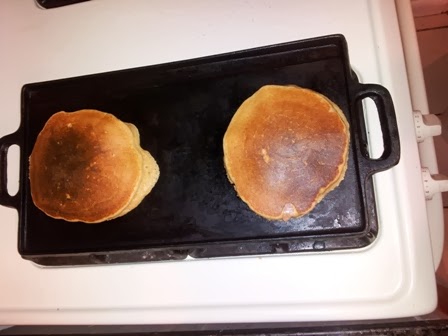
photo by Alan Walker
Masculinity often focuses on the once in a lifetime stuff. Great men are presidents, generals who win decisive battles, thought leaders who come up with one amazing theory, and athletes who win the big game and set the big record. While we admit that nobody says on their death bed that they wish they'd spent more time at work, somehow all that gets lost in the everyday as even those who have enough accept more money to take on the harder job and spend more time working.


Part of what women perfected over the course of eons was living for today. That didn't mean going bungee jumping, or checking things off their bucket list. After all, the bucket list is simply another way of living for the future by saying, "these are the things I want to do before I die." Living for today means making pancakes for breakfast, not because it's a special occasion, but because when we make pancakes we take care of ourselves and the people we love.

After several years of making pancakes at least one hundred times a year, I have learned from my fore mothers and put together a delicious, healthy, everyday pancake recipe that you can make in 20 minutes for a family of four. The ingredients are listed below.

food production as women's work
Putting together these pancakes is more than just providing a substantive meal for my family, it is a meditation in the things that so many boys never get to learn. It's been called "learned helplessness," but it's more than the fact that college kids don't know how to arrange their lives in a healthy and organized manner. It is the forgetting of feminine knowledge. In a few short generations, we have handed over much of our women's work, like preparing food, hosting friends and family, and repairing our clothes to agribusiness, the internet, and the garment industry. When we do this, we trade satisfying tasks considered feminine, for masculine tasks that are repetitive, abusive and undervalued. This lost knowledge is taking its toll on our diets, our environment, our pocket books, and our mental and emotional health. One major flaw with "Lean In"-style feminism is the failure to recognize the value of traditionally women's work, like making pancakes.


food production as masculine labor

As I briefly mentioned in the last blog, pay equity is a very masculine way of looking at gender equality. It is an important index, but other indices, such as time spent with one's children, health of one's domestic sphere, and closeness and number of friendships are harder to calculate, and have not been the focus of modern feminists. It is no accident that pancakes have not been the primary worry of feminists. But when feminists emphasize equality in the spheres of politics and labor to the exclusion of traditionally feminine areas, they allow extreme masculinity to dictate the terms of the movement. By contrast, the basic tenant of masculine liberation is that feminine knowledge is inherently valuable as it is, not because the masculine marketplace acknowledges its value monetarily, but because things like domestic labor and deep loving friendships are valuable in themselves for both men and women.

So, regardless of whether you are a man, a woman, or neither, take a few moments to liberate yourself a little by connecting with your friends and family over a delicious homemade (not from a box) pancake breakfast. It will be worth it.


Gather all of your implements and ingredients before you start cooking. Put your griddle over the stove at the low end of medium. You'll have to figure out the temperature yourself, but because the structure of this particular pancake batter is so robust, you have quite a lot of room for error. Whisk together the flour, baking powder, and sugar, then use the whisk to mix together the applesauce, milk, eggs, and oil in a separate bowl. Mix the liquid into the dry ingredients with a fork or spatula at first, but finish mixing with the whisk. Add milk one tablespoon at a time until the batter oozes through the whisk. See the video below to see a good consistency.

If you want to add ingredients, like chopped up apples and cinnamon, or dried cherries, add them at the end. Use your 1/2 cup measuring cup to pour the batter onto the griddle and flip after about three minutes. If you want, you can keep them warm in an oven at 180 for up to 30 minutes. Eat up and enjoy often.

Using the applesauce and white whole wheat flour makes these pancakes low calorie, moist, fluffy, and delicious, but you can trade up the applesauce and milk for buttermilk, and the flour for all-purpose if you want them fluffier for a special occasion.

When you buy pancake mix, you are paying factories money to mix the dry ingredients together, and maybe add some powdered egg, milk, and preservatives. It is less healthy, but more importantly, it is outsourcing the everyday stuff of life that makes us all happier. Enjoy your pancakes. Taste the liberation.

Ingredients:
1.5 cups of flour
2 teaspoons of baking powder
2 tablespoons of sugar
8 ounces of applesauce
10 ounces of milk
2 eggs
1 tablespoon of canola oil

tools needed:
a stove top or hot plate
a plate to put the dirty implements on
1 .5 cup measuring cup
1 tablespoon
2 mixing bowls
1 whisk
1 stirring spoon or spatula
1 cast iron pan or griddle, or any non-stick pan
1 large spatula to flip the pancakes

Tuesday, August 21, 2012

Domestic Violence is Gendered Violence

"If you are interested in working to end gender-based violence," the woman said to the room of students seeking their masters in criminal justice, "come see me."

Photo by Ben Pollard
Wow! I thought, I am interested in working to end gender-based violence. According to several studies available on the American Bar Association's webpage, the perpetrators of domestic violence and rape are overwhelmingly male. The teacher at the criminal justice school called these acts gender-based because she was looking at the gender of the victims. I am worried that 85-95% of the perpetrators are men.

Gender's Victimization

It isn't just that traditional gender has something to do with the victimization of women. Traditional masculinity causes the victimization of women. The old-school feminist movement of the 60's spoke a lot about the bribes, the carrots of masculinity, because women wanted a piece of that action. However, little has been said about the punishments, the sticks of masculinity.

This unattributed painting is a great metaphor for how a boy may manage to be feminine but not feminized; wield violence.
In an earlier blog, I described the cycle of masculanization, but I can summarize it here. A properly masculanized man must not be feminized. On the playground, when a boy refuses to fight back, he is girl-like, and he will often be subject to a beating, or at very least a tongue lashing/ostracizing. Masculanization is a relational activity. In order to be a "man/boy," all you have to do is point to something that is not you and say that's a "woman/girl." According to traditional masculinity, anything that is victimized is feminine, so if you victimize somebody, you are proving your masculinization. Too often, the thing feminized is another male who must then prove his masculinity. It is a desperate and impossible cycle that can only lead to more and more violence. This violence is often directed at our loved ones or even strangers in a movie theater.

That it is men who usually commit the mass stranger homicides at places like an Aurora movie theater, Virginia Tech, and Columbine is not simply a product of masculinity's influence on them. These are scared and violent people who are acting out on mental sickness. However, women are just as often unhealthy as men. Women should be committing crimes of violence just as often as men do, but they don't. It is the process of masculanization that brings unhealthy men to hurt others (even as it is the process of feminization that brings unhealthy women to hurt themselves in the cases of cutters and anorexia). So, it is indeed true that domestic violence, rape, and stalking are not just gender based, they are gender caused.

Ending the Cycle of Gender

When the professor at the school of criminal justice spoke about working to end gender based violence, she spoke about important and meaningful work. She was talking about stopping the perpetrators in their tracks by designing effective enforcement mechanisms that are sadly lacking. She was talking about making sure that women know there are places for them to turn so that they do not have to become one of the majority of women murdered by their intimate partner who had already left him. All of this is crucial work, but she was probably not talking about liberating men from masculanization so that gender caused crime will never happen again.

It may be too late for the perpetrators of gender caused crime. It may be that locking them up and restraining them is all that can be done. We cannot shame a masculanized man into feeling okay with being feminized. That only leads to more desperation in his need to masculanize himself by finding a victim. Similarly, punishing these men can't work. According to a study at the Indiana University of Pennsylvania 41% of domestic violence perpetrators reassault within 18 months of their first assault. We will never convince masculinzation to be okay with being feminized. Feminization is the thing that masculinzed men seek most to avoid. But for future generations, we can stop the gender cycle in its tracks.

In order to end gender-caused violence, we must truly value traditionally feminine skills. We must no longer denigrate housekeeping and childcare as something that liberated women seek to avoid. We must rather convince men that they are rewarding important and meaningful skills to be cultivated. In order to do that, the feminist movement needs to step up and start talking about liberating men. Because the appropriate response for a man who is recognized for being feminized is not, "who cares because women are equal," but "I appreciate you noticed because men are free."

Wednesday, July 11, 2012

Living Without Gender: A Conversation with a Trailblazer

Making Men Interview- 

Beau Laurence 7/5/2012 at the Gypsy Coffee House in Capitol Hill

Gypsy Coffee House

When I asked hir for an interview, Beau Laurence wanted to meet me beneath the fabric folds hanging from the ceiling at the Gypsy Coffee House. Beau is thin and freckled, with an Irish face and hair cropped in a pixie cut. Xi joked with a  straight face, and leaned forward in hir chair for most of our 90 minute interview, thinking and picking hir words with the intensity of a scholar.

Peeing in the Gender Woods

For Right Be Done, I was interested in hir thoughts about masculinity. Xi is making a conscious choice to adopt some of masculinity, keep some of femininity, and move to something new. If men are ever to be liberated, we must make the same kinds of choices as Beau. Because no conversation about masculinity can ignore our historical relationship to it, I started by asking about hir past. Surprisingly, Beau answered by talking about how we toilet.

Right Be Done (RBD): What is your earliest memory of what it means to be a man?

Beau Lawrence (BL): Probably the earliest difference that I remember is about how boys go to the bathroom. So, I have a brother who is two years older, and I grew up… I was born into, and until I was 10, we lived in a commune and I was the first female child. There were three boys. They were older than me. My brother and two other boys. So, I didn’t have other girls to hang out with when I was a little kid, I just had the boys.

Girls Peeing in Urinal by Paul Avril

So, we all played together. They climbed trees, so I did all of these activities and didn’t think anything of my body being different, or "I’m not supposed to do that," until it came to actually urinating and it was like, “Wait. I don’t have that. That doesn’t work for me.” I specifically remember asking my dad to teach me how to pee standing up so that I could be like the other boys. Because to me it wasn’t a boy/girl thing, it was a kid thing. Like, I couldn’t do what the other kids did. But I was the youngest one, so it’s like, you know in your kid brain, you don’t necessarily revert to gender as the reason you couldn’t do this. It’s, “I’m the youngest one and I haven’t learned yet and I want to be like the big kids and do this.”

RBD: What did your dad say?

BL: My dad was like, “Okay.” And I actually did learn. Then, I was at my grandmothers and I was like, “You wanna see?” And she was like, “you will never do that again.” That’s when I learned that it was definitely not a girl thing to do and that I was a girl. It was really her that sort of reinforced what a girl was NOT, more than, “This is what boys or men are like.”

In a society where “man” is neutral, it is normal for someone who was raised as a girl to learn only what man is not. Perhaps, the biggest problem with feminism has been that we have not discussed traditional masculinity from an objective point of view. However, Beau later told me about one person in hir life that did create from scratch a conscious definition of what it meant to be a man.  Television isn’t normally a place to break stereotypes, but xi cited one example of a man who strayed from convention.

The Radical Politics of Mork and Mindy 

BL: I hadn’t thought about T.V. shows until you asked this question. Lone Ranger.

RBD: Supermale. The Lone Ranger is definitely a super male.

BL: I remember being really offended. I was always really offended the way that he treated Tonto. I was really hyper-aware of… Wow this really is kind of awful, but straight white men were always pigs, and so whatever they did was definitely like, there are other ways to be because there are other males, and there are strong females, but these white males are awful.

Fair use for political comment,
from Mork and Mindy publicity.
BL (Cont): But, the first thing that popped into my head as an alternative male T.V. character was Mork from Mork and Mindy.

RBD: But wasn’t he an alien.

BL: He was an alien, but…

RBD: So, he wasn’t really a man.

BL: He was an alien impersonating what it was like to be a male getting coached by Mindy.

RBD: Strangers in a Strange Land sort of masculinity where he had this opportunity to point out how ridiculous masculinity was.

BL: And he could do really fun.., really childlike sorts of things and get corrected for doing gender wrong.

The writer’s of Mork and Mindy gave America a chance to question basic assumptions of masculinity, the same kind of assumptions that this blog is attempting to undermine. And here I thought I was being a radical when in fact Hollywood did it 40 years ago and in tight pants.

Condescending to be Helpful

Later, I asked about the best and the worst traits of masculinity.

RBD: So what is the worst trait that has traditionally been associated with the word masculinity?

BL: Certainly patriarchy. And condescension. But those really aren’t unique to masculinity.

RBD: What makes condescension in particular traditionally masculine?

BL: It’s so hard to separate the traditional concept of masculinity. It's so wrapped up in white northern European culture that it’s kind of like, “It’s all the same.” It may be more that whiteness, that religiousness, more than masculinity that [condescension] comes from. That manifest destiny, we know better, we’re chosen by god, sort of everything is our minion. Women and children and people of color are our property. That to me is the worst thing about traditional masculinity.

RBD: How about the best thing about traditional masculinity? The best trait?

BL: I struggle with this because the thing that I, throughout my life, have sort of really maybe wanted to emulate more than anything else is not necessarily a positive quality, but the self sacrificing is sort of…

RBD: I call it loyalty.

BL: But not just loyalty. Chivalry is a real awful thing that implies condescension and all of that negative, but the, “I’m going to take the burden on so that somebody else doesn’t have to,” is something that I’ve always really liked. I know that in a lot of ways it’s not healthy because it’s a lot of it ego, but I have always enjoyed being the kind of person that would give my seat to somebody else. Or carry something that was really heavy so that somebody didn’t have to. And it wasn’t that they’re not capable of doing it, but that I’m strong and capable, and I can help in this way. And I think that’s something I value about masculinity. That sort of willingness to, not help the old lady across the street, but sort of like, you need somebody to move heavy furniture, I can do that, and it doesn’t have to be somebody who has a penis that does it. But I think that there is that attitude of masculinity in that offer.

RBD: In a way it seems like two sides of the same coin. The thing that you dislike the worst (condescension) and the thing that you like the best about masculinity (helpfulness).

Petersburg- Caviar by Walter Smith
BL: And that’s what I really struggle with actually. And as I broaden my own awareness of who I can be, and it doesn’t have to be butch or femme. There’s been a lot of that sort of cafeteria masculinity, picking and choosing what you want to keep and what you want to reject, and it’s not just all bad. And the parts that I have traditionally thought of as good, have their origins in something that’s not necessarily positive.

The idea of cafeteria masculinity is close to the image of liberated men that I hold in my imagination. I originally conceived of writing an article about hors gendered folks for that very reason. We men who are seeking liberation are looking for role models ourselves. We are looking for people to pave the path to freedom. Those like Beau who have decided to take on the underpinnings of gender are acting as our Moses, leading us out of the constructs that have kept us in lives of solitude and violence. It is hard to imagine the threat under which they live as a result. The reaction to non-conforming gender is morbidly violent, and theirs is a unique courage born of a mix of desperation for acceptance and a rebellious character. Regardless of Beau’s reasons for trailblazing our liberation, we owe hir and those like hir a debt of gratitude.

Breaking Down Stereotypes 

At the end of our interview, we spent a long time just letting the conversation flow, and at one point I wondered if xi felt like society was becoming more free because of the breaking down of traditional gender norms in society at large.

BL: It is, but here’s the double-edged sword about all that. In the kinds of circles that I’ve traveled in, the radical political stuff. When there’s a meeting, people go around and introduce themselves and say what gender pronoun they prefer. It is sort of a thing for a lot of people to say, “It doesn’t matter.” And that’s really marginalizing and erasing for those of us who have to choose and are so aware of the choices that we make and that other people make. So when an obviously cis-gendered straight man says, “Oh, you can call me ‘she,’ I won’t be offended.”

Beau Laurence's profile pic from Facebook.
That’s really a place of privilege to be able to say that. "You do your gender so well that you won’t be offended if you are called 'she.'" For those of us who may not do gender very well, what other people perceive us as has a huge emotional impact, so that place of, “It doesn’t matter,” is like, “You’re not really taking seriously that it matters so much for some of us.”

RBD: That’s true, but being exposed to non-normative gender associations can break those stereotypes for cis-people.

BL: It absolutely can, and just like every other thing, this is sort of the natural way of progress. You have these very rigid boxes, and they start to get broken up, and then you have conventionally perceived or attitudinally conventional people who then start to co-opt the language. And that is something that is a natural progression, but it’s annoying.

(If you have a complicated relationship with masculinity, and would like to have your life broadcast on this blog, please contact me to set up your own Making Men Interview.)

Wednesday, December 1, 2010

Prince Charming

Nothing could be more true than that women have been stereotyped in children's films.  For too long, women were weak and helpless, awaiting the savior in the form of Prince Charming who would not only protect them from their peril but also marry them therefore giving meaning to their lives.

However, the films often focused on the women.  Aaron Sorkin defended his treatment of women in his new film "A Social Network" recently by saying that the multiple sexy women were objectives for his main characters, not characters in the themselves.  These Prince Charmings acted the same way in old children's films from Snow White, to Cinderella, to Lady and the Tramp, and Beauty and the Beast.  The women were weak, it is true, but the men in classic children's films were only objectives for those women to reach, overcoming their weakness by, either through brains or beauty, attracting a suitable mate.

Under the ill conceived influence of Third Wave feminism, modern children's films have attempted to make their films less sexist by making the women beautiful, brainy, and kickass.  In Princess and the Frog, and now Tangled, the princess ends up saving the incompetent Prince Charming more than once.  Rather than recreating the medium, these films have simply reversed the roles while hanging on to the discriminating values of a society that is not getting any closer to gender equality.  Now women are expected to be both man and woman, the rescuer and the rescued, while men are now impotent paralyzed objectives.  Even in this, they are still objectives because any woman worth her salt is still not worth any salt without a man, even if that man is utterly incompetent.

If we have women who can do "man things" in these films, why is it still impossible to have men who do "woman things" without it being a moment to laugh at that man's ridiculous incompetence?  I do not blame the film makers.  Film makers are merely the architects of the neurotic dreams of our society.  The particular neurosis in these films is the inability to accept that traditional women's skill has any value for men.  Equality will never be achieved until we can overcome that inability.

Wednesday, November 24, 2010

Sarah Palin is Right!

Well, almost right at any rate. Here is a remarkably insightful quote from her new book which was released yesterday. “The women’s movement used to be about honoring for women the same God-given rights that our country honored for men. It used to be about dignity and hope. It used to be about respecting women by respecting their choices—whether it is to be a nuclear engineer or a stay-at-home mom—not denigrating them when they aren’t sufficiently like men.”

  • She has correctly identified how second wave feminism has been portrayed in the popular consciousness, and why there is a backlash away from feminism today.

  • However, she is wrong in so far as she thinks that feminism writ large has ever really been about “denigrating” women's choices. Even if some women in the movement were resistant to the “stay-at-home” mom ideal, many (if not most) feminists had children themselves, loved their children, and were willing to fend off Grizzly Bears to protect those children (regardless of whether or not those Grizzlies spoke with a Minnesota accent).

  • Palin is ridiculous in so far as she accuses liberals of being bleeding heart soccer parents who spoil our kids, while at the same time accusing us of being cold hearted bastards who “denigrate” stay-at-home moms.

  • Her answer to the problem of second wave feminism is to put the “girliness” back into the newly liberated women. She does not understand that “girliness” is a bribe to keep women from true equality.

  • Lastly, her style of feminism is a direct result of the Pandora's box opened by the lipstick sex-positive third wave feminists who tried to liberate sex, fashion, and one night stands without reclaiming child rearing, housekeeping, and relationship building. It is a short walk from “Sex and the City” feminism to "Pit Bull in Lipstick" Feminism.

So how can feminists break free of the unfair portrait that Sarah Palin has had so much success selling to America? We must reclaim traditional women's knowledge by sharing it with men. When men realize what they are missing, society will no longer look to the likes of Palin for expertise on gender equality because they will realize how completely Sarah Palin has been lying to us all along.

Tuesday, November 23, 2010

Home Ec-quality 101

A massive home economics movement would help equality. Without knowing about work that has traditionally been the purview of women, men could not possibly understand the true value and skill involved in such work. The Kamahamaha Schools in Hawaii used to have cabins where their female boarding students lived with orphan infants and young children to learn the best practices of raising children. They were eliminated in the 1950's, but why? Why can't we start day care facilities, or classroom sharing that are set up in a similar way, of course under strict adult control. If we made these classes mandatory, the benefits would be significant.

  • Everyone, including men, would have knowledge about basic child rearing, including appropriate divisions of labor.
  • Fathers would be able to have at least some limited experience with babies under supervision before the were on their own.
  • The entire society would benefit from basic parenting skills, which is the fundamental building block of any society.
  • Free or low cost childcare would be built in, and both parents would be able to contribute financially as well as with real labor, creating more economic security for poor families and middle class families alike.

    Most importantly, by having class time to explore the actual science of household management, we would all value these skills that have been relegated to a lower status. In fact, this work is very important, if not the most important part of life, and should be recognized as such and taught in our schools once again, but without the division of sexual differences. We can never have true equality until we start to realize that traditionally feminine tasks, like child rearing and housekeeping, are critical to our society. We can never see these tasks as equally important as business skills unless men and women are equally knowledgeable in these tasks. Learned helplessness is in fact not learned, but a lack of learning that creates perceived valuelessness.