Thursday, February 6, 2014

Super Bowl Complex

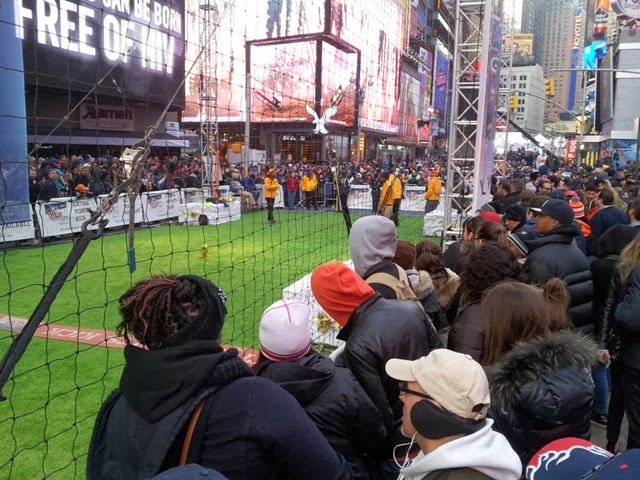
Since 2007, I have written on the Super Bowl and the complex relationship between extremist masculinity and sports. This year, I was an undercover brother in the fraternity of war-painted football fans who careened drunkenly through a Disneyfied Times Square in search of a few moments in proximity of well-known sports' figures. Need proof? Here's a video of the friendly Super Bowl crowds near the Tiffany Trophy.

Yup. I went to New York City for the Super Bowl. In the extremist masculinity hierarchy, that ranks somewhere between pissing in the woods and growing a mustache at 13. In New York, I proved that I know the difference between warriors and thugs. The Broncos were the warriors riding the Charge of the Light Brigade at the evil Sea Hawks. Also, by going I gave myself authority, subjectifying myself through useless knowledge of bizarrely esoteric skills. But mostly, I got my consolation prize. I may spend my average day at the mercy of powerful (moneyed) interests, but "we" went to the Super Bowl. By joining in, I gave myself a stake in the dickish system that is extreme masculinity.

Well, maybe it's more complex than that.

The Super Bowl is not entirely as evil as it is often made out to be. Human trafficking and sex slavery does go up during the Super Bowl, but not any more so than at any other major event, sporting or otherwise. Also, domestic violence does not raise substantially when the home team loses. Counter intuitively, it seems that domestic violence upticks slightly when the home team wins. When we think about this fact, it makes sense. When we win, we are more confident in our masculinity, and that means we are more likely to forgive ourselves a little of that extreme masculinity aggression and violence. Hey, I just confirmed that I am an awesome dominant manly dude. What do you mean you don't agree? Didn't you see the Super Bowl?

Nevertheless, football itself, and even the masculinity parade that is the Super Bowl is not the problem. Sports and athleticism are important in daily life, and if anything American men are too lazy in their gigantic houses with their haze-inducing glorified minivans (i.e. S.U.V.'s and 4 door pickup trucks). If they only took sports more seriously maybe we would be able to put an end to America's terrifyingly high obesity, heart disease, and cancer rates. Yet, somehow sports feel excessively masculine.

Because they are masculine, often excessively.

Teddy Roosevelt said football would toughen us up, big words coming from the man who named the teddy bear. The New York Knicks are better known than the New York Liberty only because they are men. Men are more likely to be sports' viewers. People have been desperate to tie sports to masculinity for decades, but the women's movement refused to accept that sports were inherently male, and in doing so they showed that the relationship between sports and masculinity was as forced and false as the relationship between Rand Paul and reality.

Title IX is so successful because it takes sports out of traditional masculinity and makes them accessible to girls, and the women those girls become. Girls who join sports teams through Title IX are more successful on and off the field/court. They are healthier, better students, and less likely to suffer from emotional handicaps. Without a doubt, sports can be a positive influence on women as well as men. It is a part of the traditionally masculine platter that women picked up and said, "Yeah, we like that."

And that is exactly the point of men's liberation. Men too, should be able to pick up what they like from femininity and say, "Yeah, we like that." And as significantly, men should be able to put down those parts of masculinity that are dickish.

The trite thoughtless response to that goal is, "why can't men do that now?" If you've been reading this blog you probably already have some ideas, but the short answer is that most men don't even know that they want it. Just as many women in the fifties honestly told themselves that they didn't want to leave the home and join the work force, many men today honestly don't want to learn how to maintain a house, raise a child, or engage in meaningful healthy relationships. And the task of convincing men that using only what they want from masculinity will make them happy is harder than the task of convincing women because the consolation prize for men is so much better ($1.22 on every dollar that a woman earns, for example).


But the consolation prize is looking more hollow after the Great Recession. The successful job, the stability, and all of the toys were never more than a chimera, but now they are completely out of reach to a younger generation of men. We are looking at the two big platters of masculinity and femininity, and thinking, "I'd like a little bit of this, and some of that, and maybe a pinch or two from over here."

The Super Bowl, like most things including suburban living, S.U.V.'s and even the military, is a complex of the terrific alongside the terrible. Some things, like the community that I felt wandering Times Square with hundreds of thousands of other football fans, are great. Some things, like the suicide rates of pro football players after suffering head traumas, are tragic. Liberation isn't necessarily about doing things differently. Liberation is having the wisdom to know what parts of our lives make us happier, and the courage to dump the rest of the bull shit in the face of people who lack the aforementioned wisdom.

Tuesday, January 28, 2014

Everyday Man: Pancakes (Mancakes?)


photo by Alan Walker
Masculinity often focuses on the once in a lifetime stuff. Great men are presidents, generals who win decisive battles, thought leaders who come up with one amazing theory, and athletes who win the big game and set the big record. While we admit that nobody says on their death bed that they wish they'd spent more time at work, somehow all that gets lost in the everyday as even those who have enough accept more money to take on the harder job and spend more time working.


Part of what women perfected over the course of eons was living for today. That didn't mean going bungee jumping, or checking things off their bucket list. After all, the bucket list is simply another way of living for the future by saying, "these are the things I want to do before I die." Living for today means making pancakes for breakfast, not because it's a special occasion, but because when we make pancakes we take care of ourselves and the people we love.

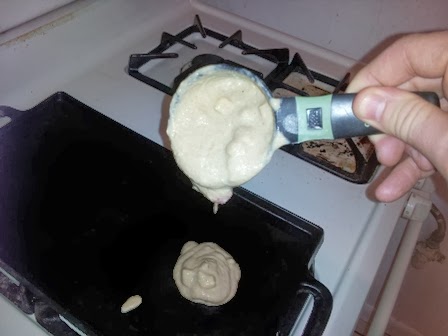
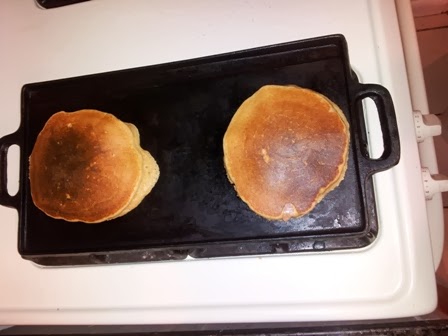
After several years of making pancakes at least one hundred times a year, I have learned from my fore mothers and put together a delicious, healthy, everyday pancake recipe that you can make in 20 minutes for a family of four. The ingredients are listed below.

food production as women's work
Putting together these pancakes is more than just providing a substantive meal for my family, it is a meditation in the things that so many boys never get to learn. It's been called "learned helplessness," but it's more than the fact that college kids don't know how to arrange their lives in a healthy and organized manner. It is the forgetting of feminine knowledge. In a few short generations, we have handed over much of our women's work, like preparing food, hosting friends and family, and repairing our clothes to agribusiness, the internet, and the garment industry. When we do this, we trade satisfying tasks considered feminine, for masculine tasks that are repetitive, abusive and undervalued. This lost knowledge is taking its toll on our diets, our environment, our pocket books, and our mental and emotional health. One major flaw with "Lean In"-style feminism is the failure to recognize the value of traditionally women's work, like making pancakes.


food production as masculine labor

As I briefly mentioned in the last blog, pay equity is a very masculine way of looking at gender equality. It is an important index, but other indices, such as time spent with one's children, health of one's domestic sphere, and closeness and number of friendships are harder to calculate, and have not been the focus of modern feminists. It is no accident that pancakes have not been the primary worry of feminists. But when feminists emphasize equality in the spheres of politics and labor to the exclusion of traditionally feminine areas, they allow extreme masculinity to dictate the terms of the movement. By contrast, the basic tenant of masculine liberation is that feminine knowledge is inherently valuable as it is, not because the masculine marketplace acknowledges its value monetarily, but because things like domestic labor and deep loving friendships are valuable in themselves for both men and women.

So, regardless of whether you are a man, a woman, or neither, take a few moments to liberate yourself a little by connecting with your friends and family over a delicious homemade (not from a box) pancake breakfast. It will be worth it.


Gather all of your implements and ingredients before you start cooking. Put your griddle over the stove at the low end of medium. You'll have to figure out the temperature yourself, but because the structure of this particular pancake batter is so robust, you have quite a lot of room for error. Whisk together the flour, baking powder, and sugar, then use the whisk to mix together the applesauce, milk, eggs, and oil in a separate bowl. Mix the liquid into the dry ingredients with a fork or spatula at first, but finish mixing with the whisk. Add milk one tablespoon at a time until the batter oozes through the whisk. See the video below to see a good consistency.

If you want to add ingredients, like chopped up apples and cinnamon, or dried cherries, add them at the end. Use your 1/2 cup measuring cup to pour the batter onto the griddle and flip after about three minutes. If you want, you can keep them warm in an oven at 180 for up to 30 minutes. Eat up and enjoy often.

Using the applesauce and white whole wheat flour makes these pancakes low calorie, moist, fluffy, and delicious, but you can trade up the applesauce and milk for buttermilk, and the flour for all-purpose if you want them fluffier for a special occasion.

When you buy pancake mix, you are paying factories money to mix the dry ingredients together, and maybe add some powdered egg, milk, and preservatives. It is less healthy, but more importantly, it is outsourcing the everyday stuff of life that makes us all happier. Enjoy your pancakes. Taste the liberation.

Ingredients:
1.5 cups of flour
2 teaspoons of baking powder
2 tablespoons of sugar
8 ounces of applesauce
10 ounces of milk
2 eggs
1 tablespoon of canola oil

tools needed:
a stove top or hot plate
a plate to put the dirty implements on
1 .5 cup measuring cup
1 tablespoon
2 mixing bowls
1 whisk
1 stirring spoon or spatula
1 cast iron pan or griddle, or any non-stick pan
1 large spatula to flip the pancakes

Tuesday, January 21, 2014

Magic Daddy Kisses: Epigenetics


Did you know that daddy kisses really are magic? My three-year-old is more right than anyone thought possible.


The epigenome is the stuff in which the genome sits. EpiDNA tags DNA, highlighting and activating certain parts of the genome, and shutting down other parts. Two studies involving rodents show how epiDNA works.

The first was about how multi-generational PTSD can be handed down through mice. A group of female mice were trained to fear a certain smell. The stress altered the epiDNA near the DNA linked to that particular scent. The effect was not only that the mice had a stress response to that smell, but they're ability to smell it was heightened. The off-spring had the same reaction as their mothers, even when they had never been introduced to that smell in the presence of their mothers. In other words, the memory of being scared of something can be passed down without actually telling your children to be afraid of that thing. I guess that explains why I hate caves...

Little Gray Mouse - Mother and Children.jpgThe second study showed how PTSD can be treated through affectionate physical contact. In this study, rat pups were better able to handle stress when they were licked and cuddled in their youth. Once a mother had cuddled and licked her pup, that pup was more likely to cuddle her pup and so on, breaking the stress cycle completely. That is until they encountered the cuddle monster, and then they were all messed up forever.

In humans, this epigenetic impact has been shown to be more complicated than a simple transfer of stress, but the research has indicated that most serious stressors (think holocaust survivors) require about three generations to find their way out of the epigenetic stress bog. Not only do epigenetics cause PTSD-type reactions, epigenetic garbage increases the likelihood of many diseases, including cancer. But oxytocin is here to save the day again!

If you don't know much about oxytocin, just think about it as the child hormone. This is the hormone that is released every time you touch your child. It is the hormone that launches childbirth (pitocin is a synthetic version). It helps mom's make milk. It is present in copious amounts when adults get together to make children (or avoid making children but still enjoy themselves). Oxytocin is the gene of physical contact, and it has the side effect of cleaning off your epigenetic material. So, the research seems to imply that when we cuddle our children, we are not only helping them cope with stress now, but also helping them cope with stress in adulthood, and helping them prevent cancer. Talk about magic kisses.

Photo by Lies Thru a Lens

All of this is very cool, but why mention it on a blog devoted to liberation of men from extremist masculinity?

First of all, Dr. Elliot documents several studies in her book, "Pink Brain, Blue Brain," that show that babies who are identified as male receive less physical contact than babies whose sex is unknown or who are identified as girls (remember, that's why we didn't want to tell anyone the sex of our babies). That same book documents the fact that boys touch and are touched less throughout childhood, depriving them of the epigenetic benefits at the times in their lives when they need it most. It goes on into adulthood. I remember being single and not touching another human being except for the occasional handshake for months. Which is why, in my late 20's, I became a hugger. A bro-hugger.
Photo by Sage Ross of Ben Huh.
One of the first things I did to liberate myself was adopt and revel in the bro-hug. It's great because once you get them in a handshake, you can just pull them in and clean that epiDNA (I love cleaning my epigenome with another man ;). I don't know who invented the bro-hug, but it's hard to imagine anything that has been better for men's liberation. Thank you, bro-hug dude. We love you (imagine me bro-hugging the bro-hug inventor right now).

And on top of saving my kids from cancer, and helping me keep my emotional health, bro-hugging and daddy kisses help us break cycles of abuse.  According to multiple studies, most abusers come from abusive homes, and (in line with our epigenetic science) an abnormal number of abusers are raised in institutional settings where they are not often touched. But when children of abusers are given loving physical contact from adoptive parents, those children are far less likely to become abusers themselves. So, men who are raised with more touching are less likely to be abusers. When we think that somewhere around 90% of spouse abusers are men, it is obvious that feminism will never succeed until men can break the glass ceiling of cuddling (a task that sounds more dangerous than it is).


The Chicago Tribune posted an article mocking men's liberation as a bunch of whining from men who are making more money than women. But income inequality is not the only index of equality, it is just the overly simplistic way that Ward Cleaver would judge equality. In other words, it is the most masculine way of judging equality.

As for me, I quit my job three and a half years ago because part of gender equality is how many kisses my kids get from their parents, and how many I give to them.

Monday, January 13, 2014

More Liberated Than Ever


I am glad to be back to digging in to politics, race, class, and especially gender on right be done. The last job I took was all consuming, so all consuming that I quit. So I'm back. I'm trying to be a bit lighter, a bit sillier, and a bit less mean, but there's only so much a coot like me can do, so here goes.

I am buying new furniture.

In this case, the furniture that I am considering buying is AWESOME! It is unbelievably cool, elegant, and efficient. Essentially, I am buying Murphy Beds on steroids. But you don't have to trust me on this account. Check out the video of this furniture transitioning HERE.

Ito Pull Down
This bed is called the Ito, like "If the glove don't fit..,"

And I know you aren't reading this because you are interested in the living section of People magazine, although you might be, but that's not why you're reading this. However, for the last 6 years, it has been the basic tenant of this blog that every action we have is always already laden with prejudice, and that extends to the furniture we buy.

So how is my furniture purchase laden with prejudice? Well, this is a purchase made necessary by choices driven by a liberation philosophy. On the opposite end of liberation philosophy is "Extreme Mascunility." A major tenant of extreme masculinity is that men must subjectify themselves, that is to say that they must be the subjects of their actions, instead of the objects. This is an obvious corollary to the objectifying that men do with women, notably in the famous meat grinder Hustler cover seen here.

Playboy s Latest Cover Looks A Lot Like Hustler s Infamous 1978 Meat Grinder Cover
She looks cold.
By the way, the image on the left was this year's December Playboy cover, as posted on Sharenator.

So much for keeping it light...

File:Stamp US 1950 3c Boy Scouts of America.jpg
Like the boy scouts, the subjectified man must always "be prepared." If we are not prepared, we may find ourselves objectified, and we all know what objectification leads too, right ladies? (For reference, see Hustler's 1978 cover.)


Subjectified men are large and in charge. It is a sad fact of history that whenever too much masculinity gets comfortable, something gets conquered. In the latest installment of the ridiculous reality show that is Extreme Masculinity, American suburban men are conquering their landscapes with their McMansions. After all, our home is our castle, and we must rule all we can see.
 Martha Stewart Petsâ„¢ Shovel and Scoop Waste Kit  - PetSmart
Being prepared, and being large and in charge are as closely related as newly weds in Arkansas (that one was for you, Steph), and both play a substantial role in how men choose to live. In a society where capitalism is corrupted by commercialism, wherever there is a need, there is something to fill that need, and sometimes if there is no need, there is a marketing campaign that will create a need.

Picking up our dogs poop with a bag may be the time-tested way of dealing with that problem, but Martha Stewart will sell a pooper scooper (see left) that will do it for us faster, cleaner, and more wastefully. Renting a rug shampooer, or hiring someone to shampoo a rug would objectify us, so we buy a cut rate carpet shampooer to do it ourselves. Once a year or so, we need a truck, so we buy a truck and haul it around with us for the other 350 days. Our cars are awesome, our televisions are terrific, our tools can repair anything, our collections are complete, our technology is up-to-date, our carpets are shampooed, and our pooper is mother-fucking scoopered. Don't worry, we think to ourselves, we got this.
Metastasizing McMansion complex.


In order to keep all of this preparation in our homes, we need a garage for our truck(s), a basement to store our carpet cleaner, a shed for our tools, a room dedicated solely to our televisions, and so on and so forth. Thus was born the McMansion. A real man never has to make a choice. If we want something, we conquer it.

But we are all always already both subjects and objects in life. We are all reliant on our societies, our families, our friends, our coworkers, our communities, and yes our government, just as they are all reliant on us. Human beings are super-socializers by nature and necessity. And the line between subject and object is as imaginary as Obamacare death panels. The true path to liberation isn't encapsulating ourselves in fiefdoms made of ticky-tacky. Men must liberate ourselves. We must stop taking our lessons from "Preppers," and start reinvesting in our neighborhoods and our families.

With all of this in mind, I decided that liberation means living smaller, slower, and more socially. I decided that not "conquering" means living sustainably with a lifestyle that is more familiar in the rest of the globally developed nations, particularly in Europe and Japan. That means making choices and setting priorities. That means making do, which is the part of "being prepared" that I chose to keep from extreme masculinity.

It is sad that we are losing the philosophy of "making do" in all of this commercialized ecstasy. It is sad because study after study shows that people are happier when they do prioritize, and when they make do. Study after study shows that the house, the car, the job, and even Martha Stewart's Pooper Scooper can make us happy for up to a year, but usually more like six months, and it is simply not worth the debt,  the stress, the carbon footprint, the water demands, and the deep neurotic need to objectify the people in our lives. Because after the six months of happiness are over, the problems remain.

When I talk like that, people think I'm being a martyr. When I say I like living smaller, slower, and more socially, they think I mean that my conscience likes it. But when I look at the Ito above, I realize that modern engineering has made it possible to live comfortably and truly happily without all the toys, and without the McMansion. And when I see this beautiful desk that we will be putting in for one of the boys, I am glad that I am handing on that realization to the next generation. Because when we live small, we bump into one another. And when we bump into our loved ones, our neighbors, and our community, we are forced to think differently, and stretched to be happier, more liberated people.

Thanks for reading again after all this time.


Tuesday, August 21, 2012

Domestic Violence is Gendered Violence

"If you are interested in working to end gender-based violence," the woman said to the room of students seeking their masters in criminal justice, "come see me."

Photo by Ben Pollard
Wow! I thought, I am interested in working to end gender-based violence. According to several studies available on the American Bar Association's webpage, the perpetrators of domestic violence and rape are overwhelmingly male. The teacher at the criminal justice school called these acts gender-based because she was looking at the gender of the victims. I am worried that 85-95% of the perpetrators are men.

Gender's Victimization

It isn't just that traditional gender has something to do with the victimization of women. Traditional masculinity causes the victimization of women. The old-school feminist movement of the 60's spoke a lot about the bribes, the carrots of masculinity, because women wanted a piece of that action. However, little has been said about the punishments, the sticks of masculinity.

This unattributed painting is a great metaphor for how a boy may manage to be feminine but not feminized; wield violence.
In an earlier blog, I described the cycle of masculanization, but I can summarize it here. A properly masculanized man must not be feminized. On the playground, when a boy refuses to fight back, he is girl-like, and he will often be subject to a beating, or at very least a tongue lashing/ostracizing. Masculanization is a relational activity. In order to be a "man/boy," all you have to do is point to something that is not you and say that's a "woman/girl." According to traditional masculinity, anything that is victimized is feminine, so if you victimize somebody, you are proving your masculinization. Too often, the thing feminized is another male who must then prove his masculinity. It is a desperate and impossible cycle that can only lead to more and more violence. This violence is often directed at our loved ones or even strangers in a movie theater.

That it is men who usually commit the mass stranger homicides at places like an Aurora movie theater, Virginia Tech, and Columbine is not simply a product of masculinity's influence on them. These are scared and violent people who are acting out on mental sickness. However, women are just as often unhealthy as men. Women should be committing crimes of violence just as often as men do, but they don't. It is the process of masculanization that brings unhealthy men to hurt others (even as it is the process of feminization that brings unhealthy women to hurt themselves in the cases of cutters and anorexia). So, it is indeed true that domestic violence, rape, and stalking are not just gender based, they are gender caused.

Ending the Cycle of Gender

When the professor at the school of criminal justice spoke about working to end gender based violence, she spoke about important and meaningful work. She was talking about stopping the perpetrators in their tracks by designing effective enforcement mechanisms that are sadly lacking. She was talking about making sure that women know there are places for them to turn so that they do not have to become one of the majority of women murdered by their intimate partner who had already left him. All of this is crucial work, but she was probably not talking about liberating men from masculanization so that gender caused crime will never happen again.

It may be too late for the perpetrators of gender caused crime. It may be that locking them up and restraining them is all that can be done. We cannot shame a masculanized man into feeling okay with being feminized. That only leads to more desperation in his need to masculanize himself by finding a victim. Similarly, punishing these men can't work. According to a study at the Indiana University of Pennsylvania 41% of domestic violence perpetrators reassault within 18 months of their first assault. We will never convince masculinzation to be okay with being feminized. Feminization is the thing that masculinzed men seek most to avoid. But for future generations, we can stop the gender cycle in its tracks.

In order to end gender-caused violence, we must truly value traditionally feminine skills. We must no longer denigrate housekeeping and childcare as something that liberated women seek to avoid. We must rather convince men that they are rewarding important and meaningful skills to be cultivated. In order to do that, the feminist movement needs to step up and start talking about liberating men. Because the appropriate response for a man who is recognized for being feminized is not, "who cares because women are equal," but "I appreciate you noticed because men are free."

Thursday, August 2, 2012

Masculine Weenieism

Why Weenies Think They're Manly, and Why it Matters

Weenie- 1: frankfurter, 2: penis, 3: nerd.

Wurst Wigs by Tup Wanders
Weenies solve problems with bluster and violence. Weenies believe that dressing up like a super hero is what makes a super hero. The modern American "tough guy" is a weenie, and I mourn true toughness.

How can I mourn toughness? I am a critic of masculinity. My blog is dedicated to the notion that masculinity is a rouse that compels men to alienate themselves in lives of violence while doing terrible things to the people they care for.

But true toughness has nothing to do with masculinity. Traditional masculinity is obsessed with looking tough at the expense of actually being tough.

True Toughness is a Virtue

Men and women who float below the condescending notice of traditional historians have spent millennia being tough. Whenever a traditional history book mentions the brave troops who died on the battlefield, it neglects the farmers who worked doggedly to make the food to feed the troops. Blacksmiths slaved in the heat to make weapons and cooking pots. Women cared for children everyday despite the weather or their own health. They cooked. They gardened and raised chickens. Trench diggers dug the roads. Stone cutters made the buildings. Millions of people showed the prosaic toughness requisite for a society to persevere.
Navy SEAL Training.
Photo by U.S. Navy.

One of feminism's great successes was in allowing women to adopt toughness without being outcasts. It brought women out of their gilded cage and down to the ground where they could have greater impact on the world. Before the movement, women who adapted to circumstance were lambasted as masculine, butch, or simply bitches. But adapting to circumstance is what makes people powerful.

Walking the line between adapting and stubbornly refusing to adapt is what makes people moral and yet consistent; strong and yet kind. It is the definition of toughness, and our modern view of "toughness" is strikingly lacking in it.

S.U.V.'s= Weenie-mobiles

Dodge Ram. Photo by Rojo.
What could be more "tough" than buying a huge tank-like S.U.V? Some people buy them because they want to be up above traffic. Some men want them to haul around stuff. Some men want to be able to go up dirt roads in the countryside. Contractors and farmers have legitimate needs for trucks. If your truck is completely filled and completely emptied two times a week or more, I have no gripe with you owning a truck. 

But if your truck goes through the car wash two times a week or more, you are a weenie. If you get to a steep muddy dirt road, and you opt to stay inside your car instead of hungrily hiking it, you are a weenie. If you drive a truck everyday of the year so that you can haul your fifth wheel to go camping, instead of camping in a tent and making do, you are a weenie. If you drive a truck because it's good in the snow, you are a weenie.

Doing without is what toughness is all about. Consuming and wasting less because we know that persisting through difficulty makes us stronger and happier is what toughness is all about. S.U.V.'s  and useless pickup trucks are about waste, decadence and squishiness. But somehow they have become aligned with modern masculine toughness, along with myriad other images of our weenie-tastic masculine culture.

Racing Bicycles

Hipsters and spandex-wearing lawyers on their day off have both taken to riding bicycles meant for racing. These bikes may be light, but they are not meant to be ridden on the roads.

A fixed-gear carbon-fiber track bike. Great on the track.
Weenie gear on the street. Photo by Escuela Virtual de Deportes
Carbon fiber, while strong, is brittle and shatters without any indication that it has developed a flaw, which is why bike racers always have two backup bikes in the cars behind them. Cleats are ridiculous, uncomfortable, and offer no benefit unless you train in them 30 hours a week or more. 

Fixed gear bicycles offer powerful, lightweight, friction-free drive trains, but they are not meant to stop or swerve safely, nor account for tired legs, or steep hills. Racing bikes are not adaptable. They cannot haul around a grocery bag safely, much less a child or two. Owning one and riding it on the weekend is fun. But riding one to work because it is lighter while carrying a backpack or messenger bag that weighs fifteen pounds is silly.

How are fixie-riding hipsters, and spandex-wearing lawyers weenies? Because both of these bikes are about looking durable, and adaptable, when in fact both of the bikes are far less durable and adaptable then your run-of-the-mill huffy from Walmart. Wearing the gear is about looking like a racer, looking tough, not being tough. If your goal is to look tough, and you sacrifice true toughness to get that look, you are as weenie-fabulous as Mitt Romney (p.s. Mitt Romney is a weenie).

Masculinity Makes Weenies of Men

Worksman Bikes make bikes that
are actually tough
Today's masculinity, like so much else in modern life, is about buying power. Masculinity has become a runway show of phallic power tools, cushy interiors, and ad-space-covered sporting goods. For eighty years, advertisers have been telling us that our gender can be bought, and we gratefully believe them.

Unfortunately, masculinity cannot be bought, and the more we buy to make us feel masculine, the more we realize that we are deficient. Masculinity is a myth, a chimera. It is unattainable and deeply unsatisfying. Soldiers and sports-figures who come close to it find themselves in lives of alienation and violence. But even they spend their lives attempting to prove their masculinity, because it can be lost in the blink of an eye. It is an infinite and driving motivator, which is why it is so useful to advertisers (and morality police).

Rivendell is another company that makes actually tough bikes.
The only way out is to reject the notion that masculinity can be attained at all. The only way to feel comfortable about your own toughness is to be tough, not buy tough. Take the parts of masculinity that are valuable, like true toughness, reject the parts that are damaging, like violence and looking tough, and be your own person. Be your own man. Be tough. Be free.

Wednesday, July 11, 2012

Living Without Gender: A Conversation with a Trailblazer

Making Men Interview- 

Beau Laurence 7/5/2012 at the Gypsy Coffee House in Capitol Hill

Gypsy Coffee House

When I asked hir for an interview, Beau Laurence wanted to meet me beneath the fabric folds hanging from the ceiling at the Gypsy Coffee House. Beau is thin and freckled, with an Irish face and hair cropped in a pixie cut. Xi joked with a  straight face, and leaned forward in hir chair for most of our 90 minute interview, thinking and picking hir words with the intensity of a scholar.

Peeing in the Gender Woods

For Right Be Done, I was interested in hir thoughts about masculinity. Xi is making a conscious choice to adopt some of masculinity, keep some of femininity, and move to something new. If men are ever to be liberated, we must make the same kinds of choices as Beau. Because no conversation about masculinity can ignore our historical relationship to it, I started by asking about hir past. Surprisingly, Beau answered by talking about how we toilet.

Right Be Done (RBD): What is your earliest memory of what it means to be a man?

Beau Lawrence (BL): Probably the earliest difference that I remember is about how boys go to the bathroom. So, I have a brother who is two years older, and I grew up… I was born into, and until I was 10, we lived in a commune and I was the first female child. There were three boys. They were older than me. My brother and two other boys. So, I didn’t have other girls to hang out with when I was a little kid, I just had the boys.

Girls Peeing in Urinal by Paul Avril

So, we all played together. They climbed trees, so I did all of these activities and didn’t think anything of my body being different, or "I’m not supposed to do that," until it came to actually urinating and it was like, “Wait. I don’t have that. That doesn’t work for me.” I specifically remember asking my dad to teach me how to pee standing up so that I could be like the other boys. Because to me it wasn’t a boy/girl thing, it was a kid thing. Like, I couldn’t do what the other kids did. But I was the youngest one, so it’s like, you know in your kid brain, you don’t necessarily revert to gender as the reason you couldn’t do this. It’s, “I’m the youngest one and I haven’t learned yet and I want to be like the big kids and do this.”

RBD: What did your dad say?

BL: My dad was like, “Okay.” And I actually did learn. Then, I was at my grandmothers and I was like, “You wanna see?” And she was like, “you will never do that again.” That’s when I learned that it was definitely not a girl thing to do and that I was a girl. It was really her that sort of reinforced what a girl was NOT, more than, “This is what boys or men are like.”

In a society where “man” is neutral, it is normal for someone who was raised as a girl to learn only what man is not. Perhaps, the biggest problem with feminism has been that we have not discussed traditional masculinity from an objective point of view. However, Beau later told me about one person in hir life that did create from scratch a conscious definition of what it meant to be a man.  Television isn’t normally a place to break stereotypes, but xi cited one example of a man who strayed from convention.

The Radical Politics of Mork and Mindy 

BL: I hadn’t thought about T.V. shows until you asked this question. Lone Ranger.

RBD: Supermale. The Lone Ranger is definitely a super male.

BL: I remember being really offended. I was always really offended the way that he treated Tonto. I was really hyper-aware of… Wow this really is kind of awful, but straight white men were always pigs, and so whatever they did was definitely like, there are other ways to be because there are other males, and there are strong females, but these white males are awful.

Fair use for political comment,
from Mork and Mindy publicity.
BL (Cont): But, the first thing that popped into my head as an alternative male T.V. character was Mork from Mork and Mindy.

RBD: But wasn’t he an alien.

BL: He was an alien, but…

RBD: So, he wasn’t really a man.

BL: He was an alien impersonating what it was like to be a male getting coached by Mindy.

RBD: Strangers in a Strange Land sort of masculinity where he had this opportunity to point out how ridiculous masculinity was.

BL: And he could do really fun.., really childlike sorts of things and get corrected for doing gender wrong.

The writer’s of Mork and Mindy gave America a chance to question basic assumptions of masculinity, the same kind of assumptions that this blog is attempting to undermine. And here I thought I was being a radical when in fact Hollywood did it 40 years ago and in tight pants.

Condescending to be Helpful

Later, I asked about the best and the worst traits of masculinity.

RBD: So what is the worst trait that has traditionally been associated with the word masculinity?

BL: Certainly patriarchy. And condescension. But those really aren’t unique to masculinity.

RBD: What makes condescension in particular traditionally masculine?

BL: It’s so hard to separate the traditional concept of masculinity. It's so wrapped up in white northern European culture that it’s kind of like, “It’s all the same.” It may be more that whiteness, that religiousness, more than masculinity that [condescension] comes from. That manifest destiny, we know better, we’re chosen by god, sort of everything is our minion. Women and children and people of color are our property. That to me is the worst thing about traditional masculinity.

RBD: How about the best thing about traditional masculinity? The best trait?

BL: I struggle with this because the thing that I, throughout my life, have sort of really maybe wanted to emulate more than anything else is not necessarily a positive quality, but the self sacrificing is sort of…

RBD: I call it loyalty.

BL: But not just loyalty. Chivalry is a real awful thing that implies condescension and all of that negative, but the, “I’m going to take the burden on so that somebody else doesn’t have to,” is something that I’ve always really liked. I know that in a lot of ways it’s not healthy because it’s a lot of it ego, but I have always enjoyed being the kind of person that would give my seat to somebody else. Or carry something that was really heavy so that somebody didn’t have to. And it wasn’t that they’re not capable of doing it, but that I’m strong and capable, and I can help in this way. And I think that’s something I value about masculinity. That sort of willingness to, not help the old lady across the street, but sort of like, you need somebody to move heavy furniture, I can do that, and it doesn’t have to be somebody who has a penis that does it. But I think that there is that attitude of masculinity in that offer.

RBD: In a way it seems like two sides of the same coin. The thing that you dislike the worst (condescension) and the thing that you like the best about masculinity (helpfulness).

Petersburg- Caviar by Walter Smith
BL: And that’s what I really struggle with actually. And as I broaden my own awareness of who I can be, and it doesn’t have to be butch or femme. There’s been a lot of that sort of cafeteria masculinity, picking and choosing what you want to keep and what you want to reject, and it’s not just all bad. And the parts that I have traditionally thought of as good, have their origins in something that’s not necessarily positive.

The idea of cafeteria masculinity is close to the image of liberated men that I hold in my imagination. I originally conceived of writing an article about hors gendered folks for that very reason. We men who are seeking liberation are looking for role models ourselves. We are looking for people to pave the path to freedom. Those like Beau who have decided to take on the underpinnings of gender are acting as our Moses, leading us out of the constructs that have kept us in lives of solitude and violence. It is hard to imagine the threat under which they live as a result. The reaction to non-conforming gender is morbidly violent, and theirs is a unique courage born of a mix of desperation for acceptance and a rebellious character. Regardless of Beau’s reasons for trailblazing our liberation, we owe hir and those like hir a debt of gratitude.

Breaking Down Stereotypes 

At the end of our interview, we spent a long time just letting the conversation flow, and at one point I wondered if xi felt like society was becoming more free because of the breaking down of traditional gender norms in society at large.

BL: It is, but here’s the double-edged sword about all that. In the kinds of circles that I’ve traveled in, the radical political stuff. When there’s a meeting, people go around and introduce themselves and say what gender pronoun they prefer. It is sort of a thing for a lot of people to say, “It doesn’t matter.” And that’s really marginalizing and erasing for those of us who have to choose and are so aware of the choices that we make and that other people make. So when an obviously cis-gendered straight man says, “Oh, you can call me ‘she,’ I won’t be offended.”

Beau Laurence's profile pic from Facebook.
That’s really a place of privilege to be able to say that. "You do your gender so well that you won’t be offended if you are called 'she.'" For those of us who may not do gender very well, what other people perceive us as has a huge emotional impact, so that place of, “It doesn’t matter,” is like, “You’re not really taking seriously that it matters so much for some of us.”

RBD: That’s true, but being exposed to non-normative gender associations can break those stereotypes for cis-people.

BL: It absolutely can, and just like every other thing, this is sort of the natural way of progress. You have these very rigid boxes, and they start to get broken up, and then you have conventionally perceived or attitudinally conventional people who then start to co-opt the language. And that is something that is a natural progression, but it’s annoying.

(If you have a complicated relationship with masculinity, and would like to have your life broadcast on this blog, please contact me to set up your own Making Men Interview.)